Repo ↗ · Source README ↗ · Markdown & license bundle
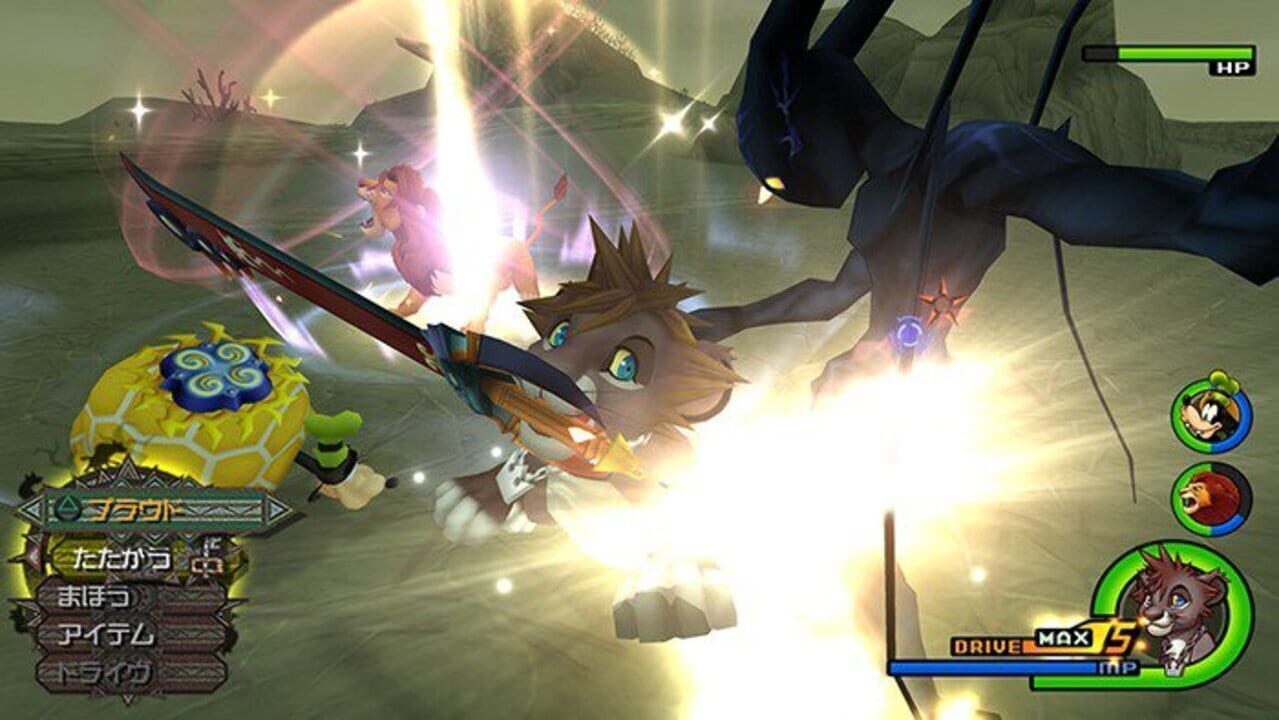
Image reference (original game): Kingdom Hearts II Final Mix · original-game screenshot, provided by IGDB. Image rights remain with their respective owners. This illustrates the referenced original game, not the actual visuals of this rewrite or mod.
Source maintainer: steferro78-HIV · Revision: 17f363b8a594 · Catalogued: 2026-10-12
Source license: MIT · LICENSE · Article: Source README (format adapted)
The source README follows, with formatting adapted for this site and images replaced by source links. Feature, completion and testing claims belong to its authors and have not been independently playtested here. The Traditional Chinese translation was prepared with AI assistance.
KH2 Combat Kit
The combat rules of Kingdom Hearts II Final Mix (Sora, base form), rebuilt as a small
Rust library you can plug into another game.
Leggi in italiano: README.it.md.
- No game files are included. The library reads a “catalog” that you generate from your
own copy of the game with the scripts intools/kh2. - No graphics, no dependencies. The library only decides what happens: which attack
starts, when a button press counts, how high a jump goes. Your game draws it. - Checked against the real game. The rules were replayed against frame-by-frame
recordings of KH2: see How faithful is it.
This is an unofficial fan project. It is not affiliated with or endorsed by Square Enix or
Disney.
What is in the box
| Folder | What it is |
|---|---|
src/kh2-combat-core |
The library (Rust, no dependencies). This is what you integrate. |
src/first-combo |
The smallest program that uses the library: it prints one combo in the terminal. |
src/arena |
A small test arena made with Bevy: a working example of a game that uses the library. |
tools/kh2 |
Python scripts that read your copy of KH2 and write the catalog (and, for the arena, Sora’s model and animations). |
docs/SPEC-FUNZIONALE.md, docs/INTERFACCIA.md |
The two documents the library was written from (in Italian): how the combat behaves, and the shape of the library, of the catalog file and of the recordings. |
PROVENANCE.md |
How the library’s code was produced: a clean-room rewrite from those two documents. |
What the library covers
- Ground and air combos: which attack starts depends on the distance, height and angle
of the target, on the enemies around, on whether you are in the air, and on the equipped
abilities. This is KH2’s own selection table, not a fixed sequence. - When a press counts: combo windows, the “your attack must have touched something”
rule, ignored presses. - Combo length and finishers: Combo Plus, Air Combo Plus, Negative Combo, Finishing
Plus, Combo Master, Berserk Charge. - Every attack ability of Sora’s base moveset: Slide Dash, Flash Step, Slapshot, Dodge
Slash, Vicinity Break, Guard Break, Explosion, Finishing Leap, Upper Slash, Aerial Sweep,
Aerial Dive, Aerial Spiral, Horizontal Slash, Aerial Finish, Magnet Burst. - Movement in the air: variable-height jump, the small hop of every air attack, falling,
landing, and the forward lunge of air attacks. - Defence: Guard, successful parry, Counterguard, weapon bouncing off an enemy guard,
being launched, Retaliating Slash, Aerial Recovery, “cannot be hit” frames.
Not covered: Dodge Roll, magic, Drive Forms, Limits, summons, reaction commands (the
library only tells you when one is allowed), enemy behaviour, damage calculation (the
formula is described in the specification, the catalog carries power and knockback of every
hit), levels and menus.
Requirements
- Rust 1.85 or newer (https://rustup.rs).
- Python 3.10 or newer (standard library only), to build the catalog.
- Your own copy of KINGDOM HEARTS -HD 1.5+2.5 ReMIX- for PC. Tested with the Steam
version, build 1.0.0.10. - OpenKH (https://github.com/OpenKH/OpenKh), used as a program to unpack the game’s
archives. - Windows, because the game and the OpenKH tools are Windows programs. The library itself
builds anywhere Rust does.
Quick start
-
Tell the scripts where OpenKH is (the folder that contains
OpenKh.Command.IdxImg.exe).
If the game is not in Steam’s default folder, also setKH2_GAME_DIRto the game folder
(the one that containsImage).$env:OPENKH_DIR = "D:\tools\OpenKH" -
Build the catalog. The game installation is only read. Everything is written to
extracted/, which Git ignores: never commit it.python tools/kh2/build_catalog.py -
Run the tests.
cargo test --manifest-path src/Cargo.toml -
See it work in the terminal: a fighter, an enemy standing still, and a player who
presses attack whenever the combo can go on. It prints what the library decides, tick by
tick (the source issrc/first-combo/src/main.rs, a good place to start reading).cargo run --manifest-path src/Cargo.toml -p first-combo -
Optional: try it in the arena. The first command prepares Sora’s model and animations
(it needsOpenKh.Research.Kh2Anim.exefrom OpenKH); without it the arena still starts.python tools/kh2/prepare_arena.pycargo run --manifest-path src/Cargo.toml -p arenaKeys:
WASDmove,Spaceattack,Kjump (hold for a higher jump),Especial
attack (square),Qguard,Xthe dummy hits you, arrows move the dummy,PgUp/PgDn
raise and lower it,Nsecond dummy,F1/F2choose an ability andF3toggle it,
1/2/3game speed. A gamepad works too.
Integrating it into your game
Who does what
| The library | Your game |
|---|---|
| Chooses the attack, runs its frames, opens and closes hit and combo windows | Reads the buttons |
| Decides the height of the character (jump, hops, fall) | Moves the character on the ground, and tells the library where the floor is |
| Gives the forward push of air attacks, tick by tick | Adds that push to the position |
| Tells you which KH2 animation is playing and at which frame | Draws the animation |
| Tells you when the weapon can hurt, and with which power | Checks whether the weapon really touched an enemy, and applies the damage |
| Runs parry, bounce, knockback and recovery | Tells the library when an enemy attack arrives or when an enemy blocks |
Time is counted in ticks of 1/60 of a second: call tick exactly 60 times per second.
Distances are in KH2 units (Sora runs 8 units per tick and a full jump is 185 units
high; the arena draws 100 units as 1 metre). Positions are [x, height, z] with height
growing upwards.
A minimal example
use std::sync::Arc;

use kh2_combat_core::catalog::Catalog;
use kh2_combat_core::combo::Event;
use kh2_combat_core::fighter::{Controls, Fighter};
use kh2_combat_core::rules::{Body, Loadout, Scene};

// Once, at start-up.
let catalog = Arc::new(Catalog::load(&Catalog::default_path()).expect("build the catalog first"));
let mut loadout = Loadout::default();
loadout.equip(catalog.ability_number("Slide_Dash").unwrap());
loadout.combo_plus = 1;
let mut sora = Fighter::new(catalog, loadout);

// 60 times per second.
let enemy = Body {
    position: [enemy_x, enemy_aim_height, enemy_z], // the point to aim at
    radius: 40.0,                                   // distances are measured from its edge
    size: 30.0,                                     // widens the height limits of the moves
};
let nearby = [enemy];
let events = sora.tick(Controls {
    attack_pressed,          // true only on the tick the button goes down
    command: None,           // Some(entry id) for Guard and the other "square" moves
    jump_pressed,
    jump_held,
    hit_landed,              // your collision check: the weapon touched an enemy this tick
    busy: false,
    berserk: false,
    floor: 0.0,              // height of the ground under the character
    scene: Scene {
        fighter: [player_x, 0.0, player_z],   // the library fills in the height
        facing: [facing_x, facing_z],         // unit vector
        main_target: Some(enemy),             // the locked-on (or chosen) enemy
        nearby: &nearby,                      // every enemy around, main target included
        ledge_ahead: false,
    },
});

// Apply what the library decided.
let push = sora.slide();
player_x += push[0];
player_z += push[1];
let player_height = sora.height();
match sora.shown() {
    Some((motion, frame)) => { /* draw KH2 animation number `motion` at `frame` (from 1) */ }
    None => { /* idle or running: your choice */ }
}
for event in events {
    match event {
        Event::MoveStarted { motion, .. } => { /* an attack started */ }
        Event::HitWindowOpened { power, .. } => { /* the weapon can hurt from now */ }
        Event::HitWindowClosed => {}
        _ => {}
    }
}
src/first-combo/src/main.rs is this loop in a program you can run; the
arena (src/arena/src/main.rs, function simulate) is the same loop inside a real game.
Things your game must tell the library
- A hit landed. While
sora.combo.hit_power()isSome(power), check whether the weapon
touches an enemy. If it does, passhit_landed: trueon that tick. Without it the combo
does not continue, exactly as in KH2.sora.combo.hit_attack()gives the number of the
hit:catalog.attack(number)has its power, knockback and the other values. - An enemy attack arrives. If
sora.combo.guarding()is true callsora.guarded(): the
blow is stopped. If it landed on a real guard the parry starts, and from there the attack
button gives Counterguard; some moves guard while they attack, and then the move simply goes
on. If
sora.combo.unhittable()is true the attack misses. Otherwise call
sora.knocked(reaction_motion, rise): the combo breaks, a damage animation plays, and
withrisegreater than zero the character is launched into the air (then Retaliating
Slash and Aerial Recovery become possible). - An enemy blocked your weapon. Call
sora.deflected().
Buttons that recall a specific move
Some moves do not come from the attack button: you pass their entry number in
Controls::command. In Sora’s catalog they are: Guard 11, Upper Slash 12, Finishing Leap 37,
Horizontal Slash 38. Counterguard (39) and Retaliating Slash (40) are recalled automatically
by the attack button when the situation is right. A command only works if the ability is
equipped and the moment is right; otherwise you get Event::PressIgnored.
Abilities
Loadout holds what is equipped. Abilities that add moves have a number:
loadout.equip(catalog.ability_number("Flash_Step").unwrap()). The names are those written
in the catalog (lines starting with ability). Abilities that change the rules are fields:
combo_plus, air_combo_plus, negative_combo, finishing_plus, combo_master,
berserk_charge. Aerial Recovery is rules::AERIAL_RECOVERY. You can change the loadout at
any time through sora.combo.loadout.
Animations
The library speaks in KH2 animation numbers (for example 151 is the first ground attack, 3
the jump, 4 the fall). It does not contain the animations. To see Sora move you have to
convert them from your copy of the game into the format of your engine: the scripts
tools/kh2/prepare_arena.py and tools/kh2/export_arena_poses.py show one way (they write
one pose per tick for every bone, which the arena plays back).
Using it from another language
The library is plain Rust with no dependencies. To call it from C, C++, C# or a scripting
language, wrap Fighter in a small cdylib crate that exposes extern "C" functions
(create, tick, read state). That wrapper is not included.
How the code was written
The library in src/kh2-combat-core is a clean-room rewrite. An earlier version was
written while studying the game. Before publishing, the behaviour was written down as a
functional specification (docs/SPEC-FUNZIONALE.md) and an interface description
(docs/INTERFACCIA.md), and the library was written again from scratch, from those two
documents and the data only, by a separate session that had access to neither the earlier
code nor the study notes. PROVENANCE.md says exactly what that session had
and did not have, and what the method does and does not guarantee. The working log and the
question-and-answer files it mentions are kept privately by the project owner, because they
contain personal names: they are not part of this repository. After the rewrite, the only
change made inside the library’s folder was two lines of package metadata in its Cargo.toml
(license and publish): configuration, not code. The two documents are here exactly as that session received them (they mention a
data\ folder: it is the working folder of the rewrite, with the catalog and the recordings).
The example, the arena and the scripts in tools/kh2 are not part of the rewrite: they only
use the library’s public interface or read the game’s data files.
How faithful is it
The rules come from three sources: the game’s own data tables (read by the scripts from your
copy), frame-by-frame recordings of the real game (“telemetry”), and a written description
of the game’s behaviour (docs/SPEC-FUNZIONALE.md). The tests replay the recordings through
the library and compare.
| What | How it was checked | Result |
|---|---|---|
| Combo rules on the ground and in the air (which presses count, when the next attack starts, when the finisher comes) | 128 recorded combos replayed | 0 differences |
| Jump and fall | 45 recorded jumps replayed, height compared at every tick | 36 within 2 units, 42 within 5 (the others hit a step or an enemy) |
| Forward lunge of air attacks | 30 recorded air attacks with a distant target | 28 travel the same distance within 8% |
| Choice of the attack for every move and ability | every entry of Sora’s catalog tested in its own situation | passes; in the real game only checked for the moves without abilities |
| Effect of Combo Plus, Negative Combo, Finishing Plus | taken from community documentation | not checked in the game |
| Guard, parry, Counterguard, Retaliating Slash, Aerial Recovery | timings from the game data; rules from the specification | tried in the arena, not checked against recordings |
| Lunge speed towards a close target; rise of ground-to-air attacks | fitted on few samples | approximate |
The recordings are not included (they come from one player’s game), so the two replay tests
skip themselves and say so. The Steam build used for all measurements is 1.0.0.10.
The catalog file
A plain text file, one thing per line, written by tools/kh2/build_catalog.py to
extracted/kh2/catalog/sora_base.catalog:
entry ...one line per move of the selection table: when it can be chosen (distance,
height, angle, ground or air, required ability) and which animation it plays;motion ...an animation and its length in ticks;span ...andpoint ...the events of an animation: hit zones, “combo allowed”,
“finisher allowed”, “cannot be hit”, and so on;attack ...the numbers of a hit: power, knockback, and so on;ability ...the number and name of an ability.
Catalog::load(path) reads it; Catalog::default_path() points to the place where the
script writes it. The catalog contains game data: keep it out of any repository.
Tests
cargo test --manifest-path src/Cargo.toml
- The tests inside the modules and
tests/interfaccia.rsuse small made-up catalogs: they
run anywhere. tests/catalogo_vero.rsuses your real catalog: it skips itself until you build it.tests/registrazioni.rsreplays game recordings from alogs/folder: it skips itself
when there are none.
A note on language
Code comments, test names and the two documents are in Italian; names in the code, and the
example, are in English.
Legal
- This repository contains no game files, no decompiled code and no extracted data. You
need your own legitimate copy of the game to generate the catalog. - Do not publish the
extracted/folder or anything generated from the game. - Kingdom Hearts is a trademark of Disney and Square Enix. This project is unofficial.
Credits
See CREDITS.md.
License
MIT, see LICENSE. It covers the code and documents of this repository, not the
game or anything generated from it.
License and provenance
The README and its translation retain MIT terms. Changes comprise translation, links and formatting. Editable Markdown, the original README, LICENSE and NOTICE files are included in the linked bundle. This grants no rights to the original games, their assets or trademarks.
LICENSE
MIT License

Copyright (c) 2026 steferro78

Permission is hereby granted, free of charge, to any person obtaining a copy
of this software and associated documentation files (the "Software"), to deal
in the Software without restriction, including without limitation the rights
to use, copy, modify, merge, publish, distribute, sublicense, and/or sell
copies of the Software, and to permit persons to whom the Software is
furnished to do so, subject to the following conditions:

The above copyright notice and this permission notice shall be included in all
copies or substantial portions of the Software.

THE SOFTWARE IS PROVIDED "AS IS", WITHOUT WARRANTY OF ANY KIND, EXPRESS OR
IMPLIED, INCLUDING BUT NOT LIMITED TO THE WARRANTIES OF MERCHANTABILITY,
FITNESS FOR A PARTICULAR PURPOSE AND NONINFRINGEMENT. IN NO EVENT SHALL THE
AUTHORS OR COPYRIGHT HOLDERS BE LIABLE FOR ANY CLAIM, DAMAGES OR OTHER
LIABILITY, WHETHER IN AN ACTION OF CONTRACT, TORT OR OTHERWISE, ARISING FROM,
OUT OF OR IN CONNECTION WITH THE SOFTWARE OR THE USE OR OTHER DEALINGS IN THE
SOFTWARE.
Comments
…