Repo ↗ · Source README ↗ · Markdown & license bundle
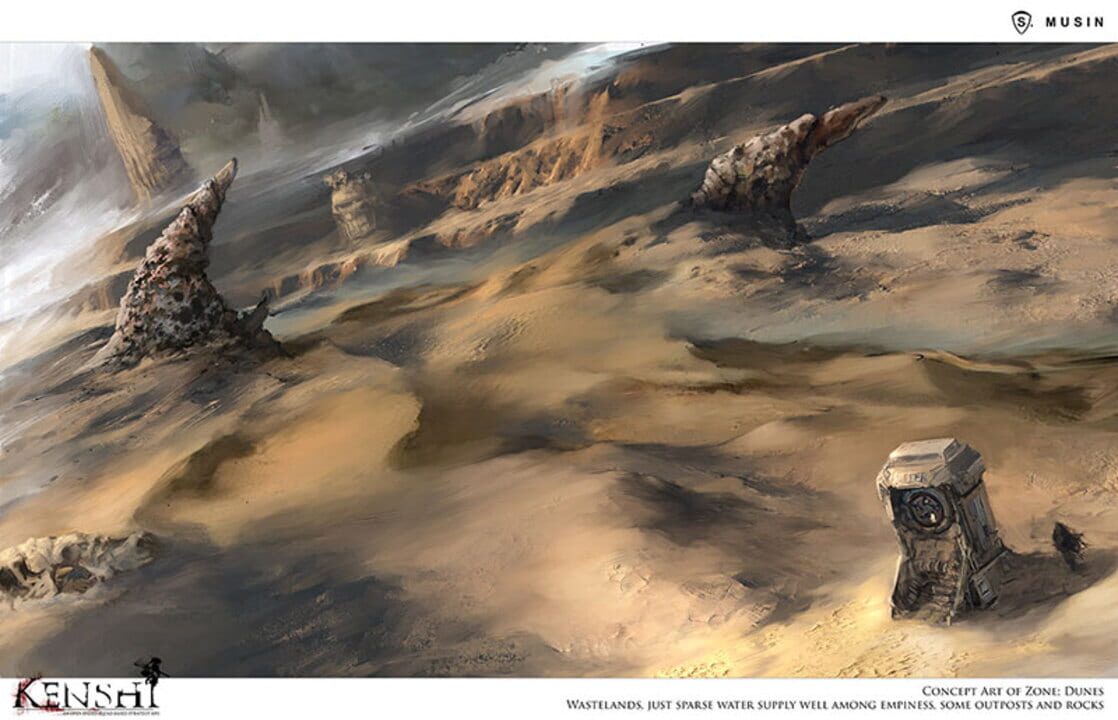
Image reference (original game): Kenshi · original-game artwork, provided by IGDB. Image rights remain with their respective owners. This illustrates the referenced original game, not the actual visuals of this rewrite or mod.
Source maintainer: brayniac6-glitch · Revision: 48530b9359a9 · Catalogued: 2026-10-12
Source license: MIT · LICENSE · Article: Source README (format adapted)
The source README follows, with formatting adapted for this site and images replaced by source links. Feature, completion and testing claims belong to its authors and have not been independently playtested here. The Traditional Chinese translation was prepared with AI assistance.
Project Okran
A from-scratch, open rewrite of Kenshi: its own engine and game code (Rust and Bevy), playing the
original game’s data from your own copy of Kenshi. It’s like OpenMW for Morrowind.
You need Kenshi. Project Okran contains none of Kenshi’s files: no data, models, textures,
sounds or executable. It reads them from your installed copy (Steam or GOG) every time it runs,
and it won’t start without one. Buy Kenshi from Lo-Fi Games on
Steam or GOG.
Status: early and playable. You can start a new game from Kenshi’s starts, or continue, save,
load and import your Kenshi saves. You can walk, fight, trade, recruit, build, research and talk
your way across the world, but much is still missing or rough. Save often.
Download and play (Windows)
- Own and install Kenshi (Steam or GOG).
- Go to this repo’s Releases page and
downloadProject-Okran-windows.zipfrom the newest release. - Unzip it anywhere (your Desktop is fine) and run
kenshi.exe. If Windows SmartScreen warns about
an unknown app, choose More info, then Run anyway.
That’s all: the download is one program, and it reads everything else from your Kenshi install. It
finds a Steam install on its own. If yours is elsewhere (GOG, another drive), start it with the
Kenshi folder: kenshi.exe "D:\Games\Kenshi".
System requirements
Measured on the development PC; the minimum is an estimate, not tested on that hardware.
| Minimum | Recommended | |
|---|---|---|
| OS | Windows 10 or 11, 64-bit | Windows 11, 64-bit |
| CPU | 4 cores (Intel i5-8400 / Ryzen 5 2600) | 6 cores (Intel i5-12400F, tested) |
| Memory | 16 GB RAM | 32 GB RAM |
| Graphics | DirectX 12 or Vulkan, 6 GB (GTX 1660) | 8 GB (RTX 4060, tested) |
| Storage | Kenshi installed (about 14 GB), plus 100 MB | an SSD |
It uses a lot of memory: about 7.5 GB, and up to 13 GB committed, after a minute in a town. It ran
well on the 16 GB test PC, but close other big programs if you only have 16 GB.
Building it yourself
- Install Kenshi.
- Install Rust (stable, 1.85 or newer).
- Build and run:
cargo build --release -p kenshi-game --bin kenshi
target/release/kenshi.exe
It finds a Steam install of Kenshi on its own. Otherwise, give it the Kenshi folder:
kenshi.exe "D:\Games\Kenshi". Nothing is written into your Kenshi folder. Settings and saves go
to %APPDATA%\kenshi-rewrite, and Kenshi’s own saves are only ever read (Import).
Mods
Kenshi mods work: Steam Workshop subscriptions and Kenshi/mods/<Name>/ folders, loaded in your
launcher’s order. Project Okran can also keep its own mod list, and a mod’s files replace the
game’s by name. See MODDING.md for making mods, the load order, replacing models,
textures and UI, and changing the code itself.
How this repo works
The rewrite is planned in sheet/ (the Spreadsheet Method). Every function of Kenshi’s executable
is a row in sheet/functions.tsv with the subsystem it belongs to and a one-line description of
what it does. sheet/port_map.tsv maps Kenshi’s systems to the rewrite’s modules. Code is written
from those descriptions, never copied from decompiled code. See CLAUDE.md for the rules,
sheet/SCHEMA.md for the schema and docs/DESIGN.md for the plan.
cargo test
python tools/sheet.py coverage --by sub
Legal
Not affiliated with Lo-Fi Games. No game files, executables or decompiled code are included; you
need your own copy of Kenshi. Kenshi is a trademark of Lo-Fi Games. Project Okran’s own code is MIT
licensed (LICENSE).
The sound code (src/audio) rebuilds Kenshi’s Wwise Vorbis sounds as Ogg Vorbis by ww2ogg’s method
and ships ww2ogg’s packed codebooks (src/audio/data/packed_codebooks_aoTuV_603.bin):
Copyright © 2002, Xiph.org Foundation; Copyright © 2009-2016, Adam Gashlin; BSD licence in
src/audio/data/ww2ogg_COPYING. Kenshi’s own sounds are read from your install at run time, never
copied.
License and provenance
The README and its translation retain MIT terms. Changes comprise translation, links and formatting. Editable Markdown, the original README, LICENSE and NOTICE files are included in the linked bundle. This grants no rights to the original games, their assets or trademarks.
LICENSE
MIT License

Copyright (c) 2026 brayniac6-glitch

Permission is hereby granted, free of charge, to any person obtaining a copy
of this software and associated documentation files (the "Software"), to deal
in the Software without restriction, including without limitation the rights
to use, copy, modify, merge, publish, distribute, sublicense, and/or sell
copies of the Software, and to permit persons to whom the Software is
furnished to do so, subject to the following conditions:

The above copyright notice and this permission notice shall be included in all
copies or substantial portions of the Software.

THE SOFTWARE IS PROVIDED "AS IS", WITHOUT WARRANTY OF ANY KIND, EXPRESS OR
IMPLIED, INCLUDING BUT NOT LIMITED TO THE WARRANTIES OF MERCHANTABILITY,
FITNESS FOR A PARTICULAR PURPOSE AND NONINFRINGEMENT. IN NO EVENT SHALL THE
AUTHORS OR COPYRIGHT HOLDERS BE LIABLE FOR ANY CLAIM, DAMAGES OR OTHER
LIABILITY, WHETHER IN AN ACTION OF CONTRACT, TORT OR OTHERWISE, ARISING FROM,
OUT OF OR IN CONNECTION WITH THE SOFTWARE OR THE USE OR OTHER DEALINGS IN THE
SOFTWARE.
Comments
…